
Explore the Universe
Discover the cosmos: Planets & Moons, Stars, Galaxies, Nebulae, and Black Holes. Dive into the detailed science of our universe.

PLANETS & MOONS
JUPITER
The Gas Giant
SCIENTIFIC DATA
Type: Gas Giant
Distance from Sun: 778 million km
Moons: 95
Diameter: 139,820 km
Orbital Period: 11.9 years
Explore
Description
The largest planet in our solar system, Jupiter’s immense gravity and Great Red Spot make it one of the most fascinating worlds. Its powerful storms and magnetic field dominate the outer solar system.
SCIENTIFIC DATA
Type: Ice Giant
Distance from Sun: 2.9 billion km
Moons: 27
Diameter: 50,724 km
Rotation Axis: Tilted 98° (spins on
its side)
Explore
Description
Uranus is a pale blue planet with extreme seasonal changes, caused by its unique sideways rotation. Its atmosphere of hydrogen, helium, and methane gives it its icy blue-green color and frigid temperatures.
URANUS
The Ice Giant
SATURN
The Ringed Planet
SCIENTIFIC DATA
Type: Gas Giant
Distance from Sun: 1.4 billion km
Moons: 146
Rings: Ice and rock debris
Diameter: 120,536 km
Explore
Description
Saturn’s majestic ring system makes it one of the most recognizable planets. Composed mostly of hydrogen and helium, Saturn’s beauty hides a stormy, turbulent atmosphere with extreme winds and swirling clouds.
SCIENTIFIC DATA
Type: Terrestrial
Distance from Sun: 150 million km
Moons: 1 (The Moon)
Diameter: 12,742 km
Orbital Period: 365 days
Explore
Description
Our home world, Earth is the only known planet to support life. Covered mostly by oceans and protected by a life-sustaining atmosphere, it is a delicate balance of land, water, and air that makes life possible.
EARTH
The Blue Planet

STARS & CONSTELLATIONS
SIRIUS (α CMa)
The Dog Star
SCIENTIFIC DATA
Constellation: Canis Major
Apparent Magnitude: −1.46
Distance from Earth: 8.6 light-years
Spectral Type: A1V
System: Binary
Explore
Description
Sirius, the brightest star visible from Earth, shines brilliantly in the constellation Canis Major. It is actually a binary system — a main-sequence star (Sirius A) and a faint white dwarf companion (Sirius B).
SCIENTIFIC DATA
Constellation: Orion
Type: Red Supergiant
Distance: ~642 light-years
Spectral Class: M1–M2 Ia–ab
Radius: ~950 times that of the Sun
Explore
Description
A colossal red supergiant nearing the end of its life, Betelgeuse is one of the largest and most luminous stars known. When it eventually explodes as a supernova, it will briefly outshine the entire night sky.
BETELGEUSE (α Ori)
The Gas Giant
POLARIS (α UMi)
The North Star
SCIENTIFIC DATA
Polaris marks true north in the
night sky.  It’s a multi-star
system and a Cepheid variable
whose brightness changes
over time.
Explore
Description
Polaris, the North Star, has guided travelers for centuries. As a multi-star system and a pulsating Cepheid, its rhythmic brightness and role in navigation make it one of the most iconic stars in the night sky.
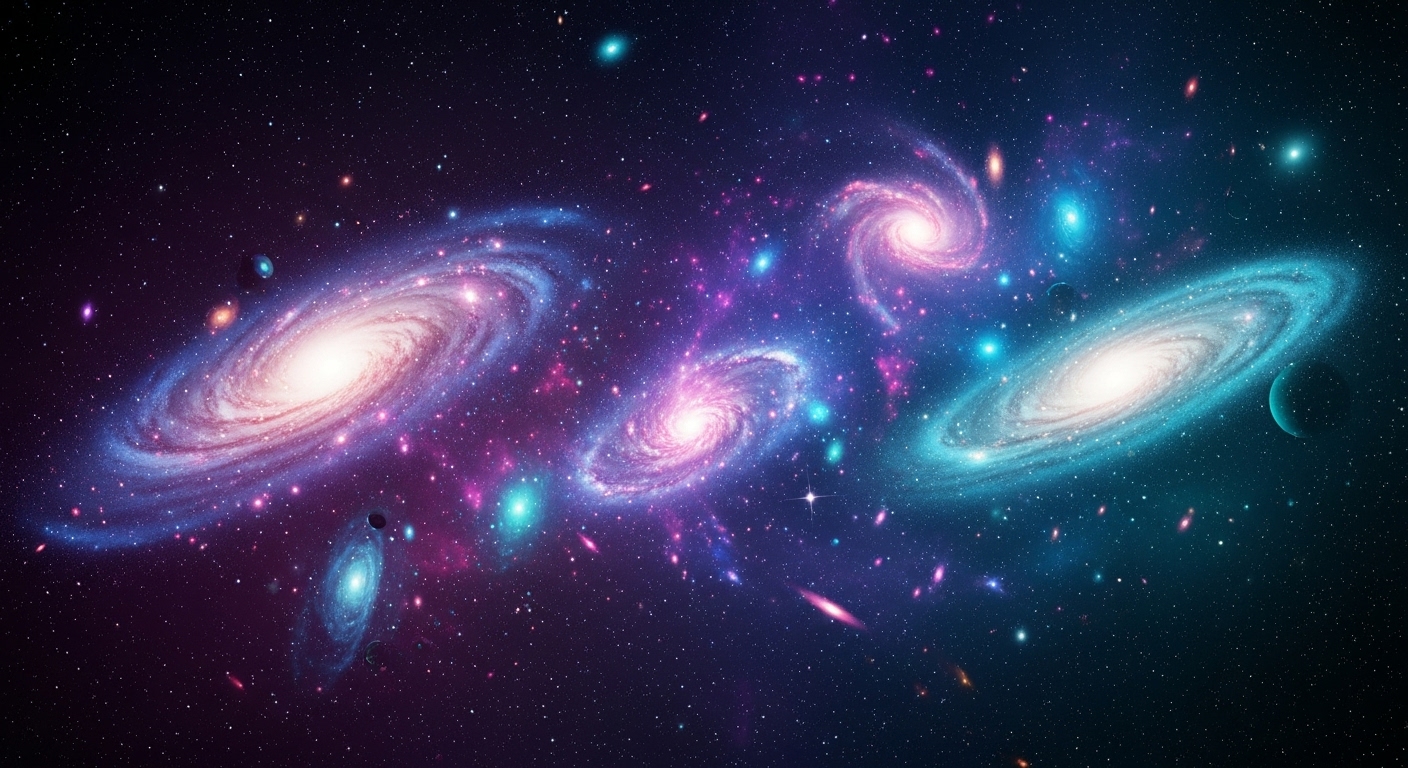
GALAXIES
MILKY WAY
Our Home Galaxy
SCIENTIFIC DATA
Type: Barred Spiral Galaxy
Diameter: ~100,000 light-years
Stars: 100–400 billion
Distance to Center: 26,000
Central Object: Sagittarius A*
Explore
Description
The Milky Way is the galaxy we call home — a vast spiral system of stars, gas, and dust. Its glowing arms stretch across the night sky, containing our solar system and billions of other worlds.
ANDROMEDA
Nearest Major Galaxy
SCIENTIFIC DATA
Type: Spiral Galaxy
Distance from Earth: 2.5 million
Diameter: 220,000 light-years
Stars: ~1 trillion
Explore
Description
The Andromeda Galaxy is the closest spiral galaxy to the Milky Way and the largest in our Local Group. Astronomers predict that one day, our two galaxies will merge to form a giant elliptical galaxy.
SOMBRERO
The Hat-Shaped Galaxy
SCIENTIFIC DATA
Type: Spiral Galaxy with large
central bulge
Distance: 29 million light-years
Diameter: 50,000 light-years
Distinctive Feature: Bright nucleus
Explore
Description
Named for its resemblance to a sombrero hat, this galaxy features a glowing core surrounded by a thick dust lane. Its symmetry and brightness make it one of the most photogenic galaxies in the universe.
WHIRLPOOL
A Galactic Dance
SCIENTIFIC DATA
Type: Spiral Galaxy (Interacting Pair)
Distance: 27 million light-years
Diameter: 76,000 light-years
Companion Galaxy: NGC 5195
Constellation: Canes Venatici
Explore
Description
The Whirlpool Galaxy is famous for its perfectly defined spiral arms and close companion galaxy, NGC 5195. Their gravitational interaction has triggered bursts of star formation across its structure.

NEBULAE
ORION NEBULA
A Stellar Nursery
SCIENTIFIC DATA
Type: Emission Nebula
Distance from Earth: 1,344 light-
years
Diameter: 24 light-years
Constellation: Orion
Explore
Description
The Orion Nebula is one of the brightest nebulae visible to the naked eye. It’s a vast cloud of glowing gas where new stars and planetary systems are being born — a living laboratory of cosmic creation.
CRAB NEBULA
A Supernova Remnant
SCIENTIFIC DATA
Type: Supernova Remnant
Distance: 6,500 light-years
Diameter: 11 light-years
Constellation: Taurus
Core Object: Neutron Star
Explore
Description
The Crab Nebula is the aftermath of a massive supernova explosion first recorded by Chinese astronomers in 1054 AD. Its center harbors a rapidly spinning neutron star that powers the nebula’s radiation.
EAGLE NEBULA
Home of the Pillars of Creation
SCIENTIFIC DATA
Type: Emission Nebula
Distance: 7,000 light-years
Diameter: 70 light-years
Constellation: Serpens
Explore
Description
The Eagle Nebula is a vast cloud of gas and dust famous for the “Pillars of Creation” — towering structures sculpted by radiation from newborn stars. It’s one of the most iconic images captured by the Hubble Telescope.

BLACK HOLES
SAGITTARIUS A*
The Heart of the Milky Way
SCIENTIFIC DATA
Type: Supermassive Black Hole
Distance from Earth: 26,700 light
Mass: ~4.3 million × the Sun
Location: Center of the Milky
Way Galaxy
Explore
Description
Sagittarius A* sits quietly at the core of our galaxy, surrounded by swirling gas and stars moving at incredible speeds. It’s the gravitational anchor of the Milky Way, a region where time and space warp beyond comprehension.
CYGNUS X-1
A Stellar-Mass Black Hole
SCIENTIFIC DATA
Type: Stellar Black Hole
Distance: 6,070 light-years
Mass: ~21 × the Sun
Companion Star: HDE 226868
Constellation: Cygnus
Explore
Description
Cygnus X-1 was one of the first black holes ever discovered. Detected through its powerful X-ray emissions, it devours matter from its companion star, proving Einstein’s theories in stunning cosmic fashion.
TON 618
The Colossus of the Cosmos
SCIENTIFIC DATA
Type: Supermassive Black Hole
Distance: ~10.4 billion light-years
Mass: ~66 billion × the Sun
Event Horizon Diameter: ~390
Host Galaxy: Quasar TON 618
Explore
Description
TON 618 is one of the largest and most luminous black holes known, a true cosmic giant. Its mass defies imagination, with a gravitational field so powerful that it bends light across galaxies.